

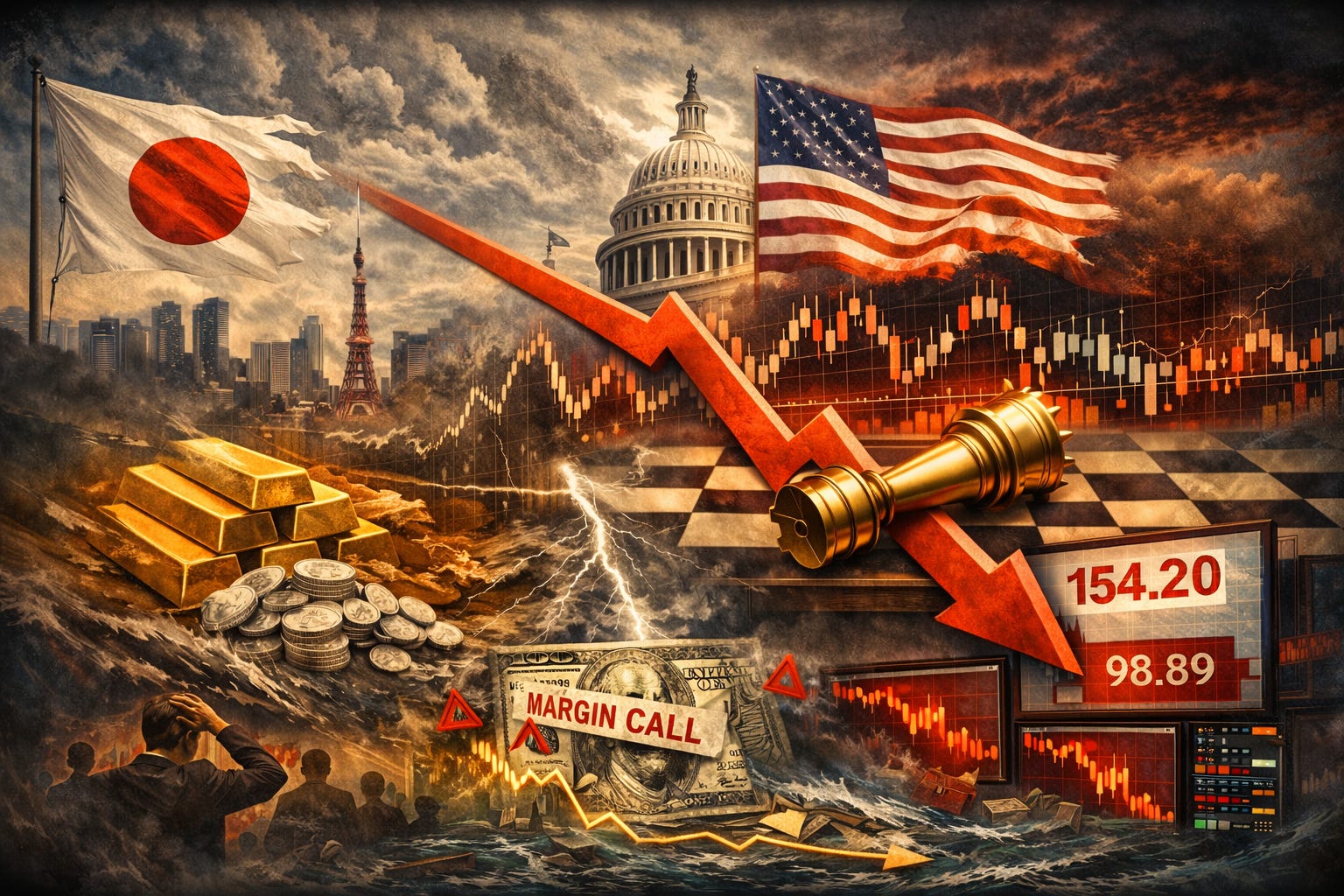
Author’s note: This post is part of Capital Wars Uncovered—a running series on how policy tools (tariffs, balance-sheet moves, and funding backstops) propagate through the dollar system via liquidity, collateral, and risk constraints, written clearly for professionals and non-finance folks. The arc so far tracks market news in real time: “Tariffs Are Rewiring the Dollar System” (trade policy → money stress), “The Gold and Silver Crash Was Driven by Governments, Not Markets” (funding regime break → forced repricing), “What Multiple Markets Are Confirming About the Capital War” (cross-asset stabilization → states winning the funding battle), and “What Scott Bessent Meant When He Said Gold Helps America” (U.S. balance-sheet optionality). and “Is China Bending Finance Without a Reserve Currency?” (trade gravity → settlement influence). Together, these pieces build a single framework: what looks like disconnected volatility is often sovereign levers affecting different market. Going forward, I’ll keep tracking the signals as they develop—funding stress, settlement shifts, and sovereign balance-sheet moves; consider a paid subscription for the full analyses as this series unfolds.
This week something deeply unusual happened in global financial markets.
Gold prices surged nearly 28% in a matter of days, the fastest rise since the early 1980s. Silver climbed an astonishing 66%, briefly touching $120 an ounce. Then, almost without warning, both collapsed—gold fell 14%, silver 17% in under 48 hours, erasing roughly $1.7 trillion in global market value.
To anyone watching, the move felt violent, chaotic, inexplicable. The explanations arrived quickly and predictably. Some insisted governments had secretly intervened—crushing precious metals to save banks or suppress inflation signals. Others blamed panic: a sudden loss of confidence spreading through a fragile system.
Both stories miss what actually happened. Just a week ago we heard Ray Dalio warn of “capital wars.” That might be an elegant way to frame what actually did happen.
Nothing was secret. Nothing was panic. What unfolded was a major reset—the inevitable outcome of a long-brewing structural shift, driven not by markets but by states, and framed by incentives rather than intent.
The Hidden Subsidy the World Lived On
For decades, the global financial system ran on something quietly extraordinary: cheap Japanese money.
Think of Japan as a very wealthy grandmother.
She had saved for decades. She didn’t need high returns. Stability mattered more. So she lent her money at almost no cost.
Banks, hedge funds, pension funds — all over the world — borrowed yen at near-zero rates and invested elsewhere: U.S. bonds, equities, credit, commodities, even gold.
This wasn’t reckless. It was rational. The math worked.
As long as Japanese rates stayed near zero and the yen stayed weak, borrowing was easy. Funding was plentiful. Leverage felt safe.
Over time, this became invisible plumbing — not a trade, but an assumption.
The world didn’t think of itself as borrowing from Japan.
It simply grew accustomed to the allowance.
That allowance ended in January.
Japan’s Move: Politics, Not Panic
The shift didn’t come from markets misbehaving. It came from politics catching up to arithmetic.
Prime Minister Sanae Takaichi advanced a fiscal agenda centered on Japan’s national priorities: higher defense spending, industrial policy for semiconductors and AI, tax relief, and domestic investment.
All of it required money.
Japan already carries one of the highest debt burdens in the world — over 230% of GDP. That kind of fiscal expansion cannot coexist indefinitely with near-zero interest rates.
And markets finally treated it that way.
A key Japanese government bond auction faltered. Yields jumped sharply, pushing toward levels unseen in decades.
This wasn’t a bond market “accident.”
It was a political decision finally reflected in prices.
Japan was no longer willing to subsidize global leverage while funding its own strategic future.
Capital was being called home.
How the Pressure Built: Yen, Metals, and the Dollar
The stress did not arrive all at once. It accumulated — mechanically, predictably — across ten days.
January 20 (Tuesday): The Funding Shock Begins
At 10:30 a.m. JST, Japan’s Ministry of Finance conducted a routine 20-year JGB auction.
It failed.
Bid-to-cover collapsed to 3.19, the weakest since the late 1980s. Yields jumped immediately. Within hours, long-dated Japanese government bonds were repricing in a way markets had not seen in decades.
By the end of the week:
40-year JGB yields breached 4.2%
30-year yields pushed past 3.3%
The assumption underpinning three decades of yen-funded leverage quietly broke
This mattered because funding costs, not prices, are what kill leveraged trades.
For the first time in a generation, borrowing in yen was no longer free.
January 21–22: The Yen Turns from Tool to Threat
As yields repriced, the yen followed.
USD/JPY fell from 159 → 154 in less than 48 hours.
For anyone short yen — hedge funds, macro desks, commodity traders — this was not a chart move. It was a margin problem.
A 3–4% currency move against a 10–20× leveraged position wipes out weeks of P&L instantly.
Risk desks responded the only way they can:
Raising margin requirements
Tightening collateral haircuts
Asking counterparties to post cash
Liquidity began to vanish at the edges.
January 23–27: The Flight into Hard Assets
As yen-funded leverage started unwinding, capital did what it always does when a funding regime cracks: it ran for insulation.
Gold and silver went vertical.
Gold surged from ~$4,350 to $5,596 (+28%)
Silver exploded from ~$72 to $121 (+66%)
This was not inflation hedging in the textbook sense. It was collateral substitution — traders rotating into assets perceived as funding-neutral as currency volatility surged.
But this move created its own problem.
Silver above $100 is not just a monetary signal. It is a supply-chain shock — for EVs, solar panels, defense electronics, and semiconductor manufacturing. At those levels, industrial buyers step back, and policymakers take notice.
By January 27, volatility across metals, FX, and rates was feeding on itself.
The system needed an anchor.
🔒 PAID SUBSCRIBERS CONTINUE HERE
(What follows explains why the crash became inevitable — and why it matters far beyond metals.)
