

Author’s note: This post is part of Capital Wars Uncovered—a running series on how policy tools (tariffs, balance-sheet moves, and funding backstops) propagate through the dollar system via liquidity, collateral, and risk constraints, written clearly for professionals and non-finance folks. The arc so far tracks market news in real time: “Tariffs Are Rewiring the Dollar System” (trade policy → money stress), “The Gold and Silver Crash Was Driven by Governments, Not Markets” (funding regime break → forced repricing), “What Multiple Markets Are Confirming About the Capital War” (cross-asset stabilization → states winning the funding battle), and “What Scott Bessent Meant When He Said Gold Helps America” (U.S. balance-sheet optionality). and “Is China Bending Finance Without a Reserve Currency?” (trade gravity → settlement influence). Together, these pieces build a single framework: what looks like disconnected volatility is often sovereign levers affecting different market. Going forward, I’ll keep tracking the signals as they develop—funding stress, settlement shifts, and sovereign balance-sheet moves; consider a paid subscription for the full analyses as this series unfolds.
There is a lot of noise around the dollar right now. Most of it oscillates between panic and denial. Neither is useful.
People keep talking about the dollar. But it isn’t just about the currency itself, it’s about the dollar system.
What is useful is understanding that something structural is happening beneath the headlines. By January 2026, tariffs are no longer just a tool for managing trade flows. They have become a force that reprices the dollar system itself—and that repricing is now visible at the aggregate level.
This is not a story about the dollar “losing reserve status.” That framing is lazy and wrong. It is a story about how repeated tariff threats and trade weaponization are changing incentives across the global financial system — a multi-layered, multi-actor, sprawling system — altering how money is funded, hedged, collateralized, and routed.
And once those incentives shift, the price of the dollar changes even if its dominance does not collapse.
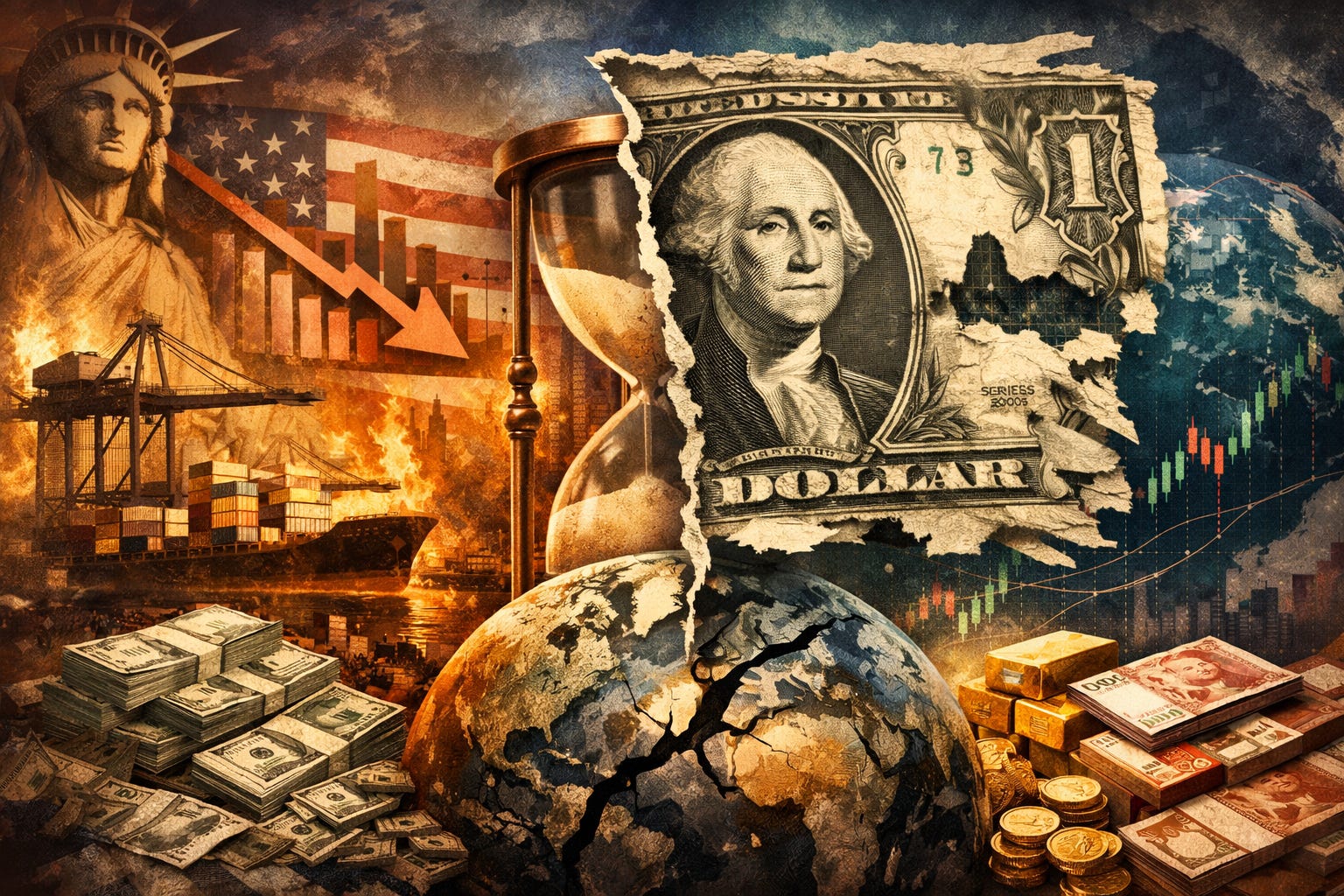
1. The Signal: Why Dollar Weakness in Early 2026 Matters
As of late January 2026, the U.S. dollar index is hovering near 97, down roughly 9–10% year over year. On its own, that number doesn’t tell you much. Context is everything.
This weakness is not occurring during a U.S. recession, nor alongside a global growth boom that would naturally favor other currencies. It is appearing amid persistent tariff threats, geopolitical escalation, and repeated use of trade access as leverage.
In previous cycles, tariff escalation typically strengthened the dollar in the short run. Risk rose, global capital ran for safety, and the dollar benefited. That reflex has weakened—and in some episodes, reversed.
What markets are signaling now is not “tariffs don’t work.” It is something more subtle and more important:
Tariffs are powerful enough to move the financial plumbing, and that movement is no longer unambiguously dollar-positive.
2. When Tariffs Start Moving Money, Not Just Goods
The mistake most people make is thinking tariffs live in shipping lanes and factories.
They don’t.
They live in balance sheets.
Modern global trade is not paid for with cash. It is financed with short-term dollar credit: importers borrow to pay suppliers, exporters discount receivables, banks fund inventories, hedge funds lever collateral, and everyone hedges currency exposure continuously. The entire system runs on the assumption that dollar cash flows will remain predictable.
When tariffs become a recurring threat, that assumption breaks.
And the break shows up immediately.
Banks don’t wait to see where factories move. They reprice risk. Collateral gets discounted more aggressively. Haircuts widen. Funding spreads rise. Dealers pull back balance sheet capacity. Hedging costs jump. None of this requires a single container ship to change course.
This is what it means to say tariffs now move the price of money.
Not interest rates alone — but access, duration, leverage, and confidence.
By 2026, tariff headlines move global finance faster than they move supply chains. That timing mismatch has created structural shifts.
